McGill 40cm Low Loss Coaxial Cable (SF-SM) for Window Pass Through Setups
The McGill 40cm coaxial cable is a short, flat low loss jumper built to cross a window frame or a wall seal. The flat profile is the whole point. A round cable gets pinched when you close a casement, while a flat one slips through the gap with little damage to the shield.
At 40cm it is meant for the last hop only: from an outdoor antenna or bulkhead on one side to the hotspot or a longer run on the other. Anything longer than about 1m at 868 MHz starts to cost you signal for no reason.
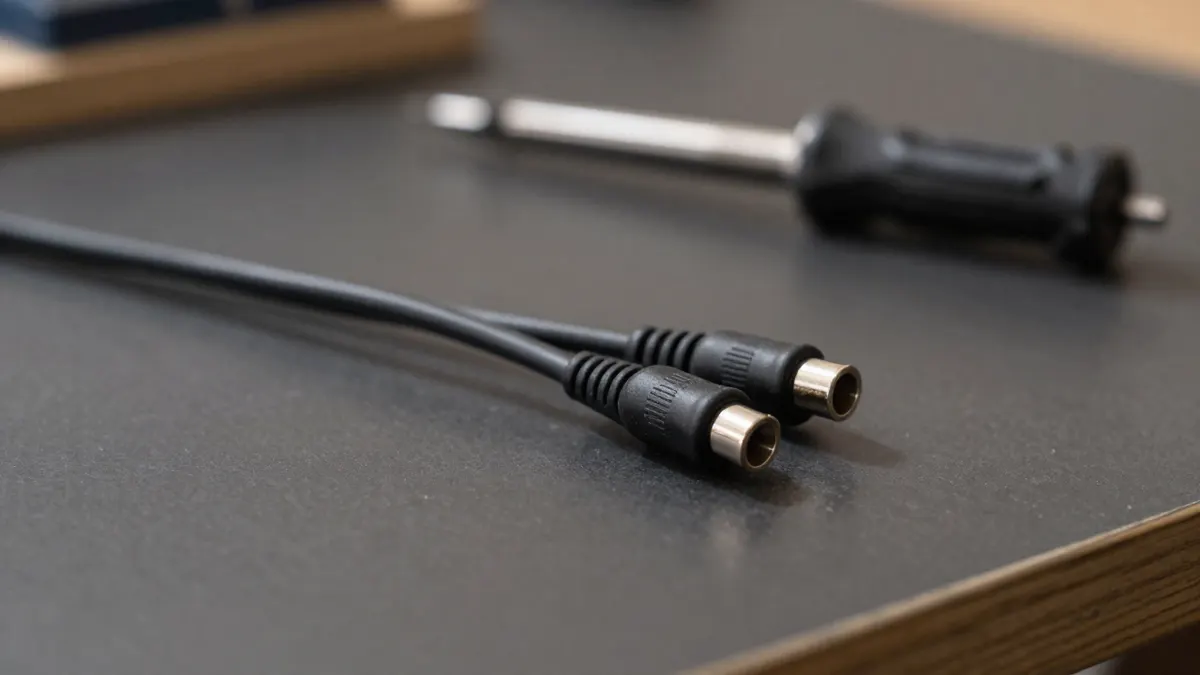
What the McGill 40cm coaxial cable is for
Most buyers of this cable run a LoRaWAN gateway indoors and want the antenna outside. Helium hotspot owners in flats are the classic case. You cannot drill the wall, the landlord says no, and the antenna works far better on a balcony rail or window ledge than behind glass.
The cable bridges that gap. One end connects to the antenna side, the other to the miner, and the window closes over the flat section.
Connector types
The SF-SM code usually points to a SMA female on one end and a SMA male on the other. Check this before anything else. A cable with the wrong gender pair simply will not mate with your hotspot or antenna, and adapters add loss at every joint.
- SMA male to SMA female: the common layout for hotspot to antenna
- N-type versions: used when the antenna has a larger N connector
- Reverse polarity SMA: found on some Wi-Fi gear, not on most LoRa miners
Signal loss over 40cm of low loss cable
Low loss flat cable of this type typically lands around 0.3 to 0.5 dB at 868 MHz over 40cm, depending on the build. Add roughly 0.1 dB for each connector pair. In practice you lose under 1 dB in total, which is hard to notice at the receiving end.
Compare that with thin RG174, which can lose 1 dB or more over the same length at 900 MHz. For a short window crossing the difference is small, yet on a hotspot already at the edge of coverage it can matter.
The loss figures change if you chain cables. Two 40cm jumpers joined by a barrel connector cost you the sum of both plus the joint. If you need more reach, buy one longer cable rather than stacking short ones.
Fitting a flat cable through a window
Close the window on the cable slowly and check the seal. Flat cables of this kind are rated for repeated closing, but you should not force a latch against the connector body. Keep both connectors outside the frame line.
Choose the hinge side or a spot near the corner, where the gap is smallest and the pressure on the cable is lowest. In winter a thin foam strip around the cable stops drafts. Rain is a different matter: the outdoor connector needs self-amalgamating tape or a proper boot, since water in an SMA joint will ruin the signal within weeks.
Other cables and adapters worth comparing
If 40cm is too short, a 45cm low loss coaxial cable with SMA male and N female ends gives you a few extra centimetres and the larger N connector toward the antenna. N connectors hold up better outdoors than SMA.
For a different layout, a Window pass through cable SMA covers the same job with matching SMA ends. When your search is about the antenna side specifically, the Helium antenna window cable guide explains which lengths suit which mounts.
Where the antenna cable has to cross a solid wall instead of a window, an N-female to N-female bulkhead adaptor lets you fix a panel through a drilled hole and connect a cable on each side.
Frequently Asked Questions
Is a 40cm cable long enough for a hotspot near a window?
Yes, if the miner sits right next to the glass, such as on a sill or a shelf directly beside it. If the device is more than about 30cm from the frame, you will probably need a 1m cable instead. Measure the actual path, including bends.
How much signal do I lose with this cable?
Expect about 0.5 to 1 dB in total at 868 MHz, including the connectors. That is small enough that most hotspot owners will not see a difference in witness counts or range.
Can I use it for Wi-Fi or 4G antennas too?
Physically yes, if the connectors match. Low loss flat cable is built for frequencies up to a few GHz, but loss grows with frequency. At 2.4 GHz the same cable may lose around twice as much as it does at 868 MHz.
Will closing the window damage the cable?
Flat cable is designed for this, but constant pressure on a sharp frame edge will wear it over time. Pad the contact point with a little foam and check the sheath every few months.