Helium Antenna Window Cable: 45cm Low Loss Coax, SMA-RP Male to N Male
A helium antenna window cable is a short, thin coaxial lead that lets you keep a LoRaWAN hotspot indoors while the antenna sits outside the glass. This 45cm version has an SMA-RP male connector on one end and an N male on the other. It is built to cross a window frame without the window needing to stay open.
The idea is simple. Glass, double glazing and metal-coated insulation all eat into a 868 MHz signal. Moving the antenna to the outer side of the pane often brings a noticeable gain in range.
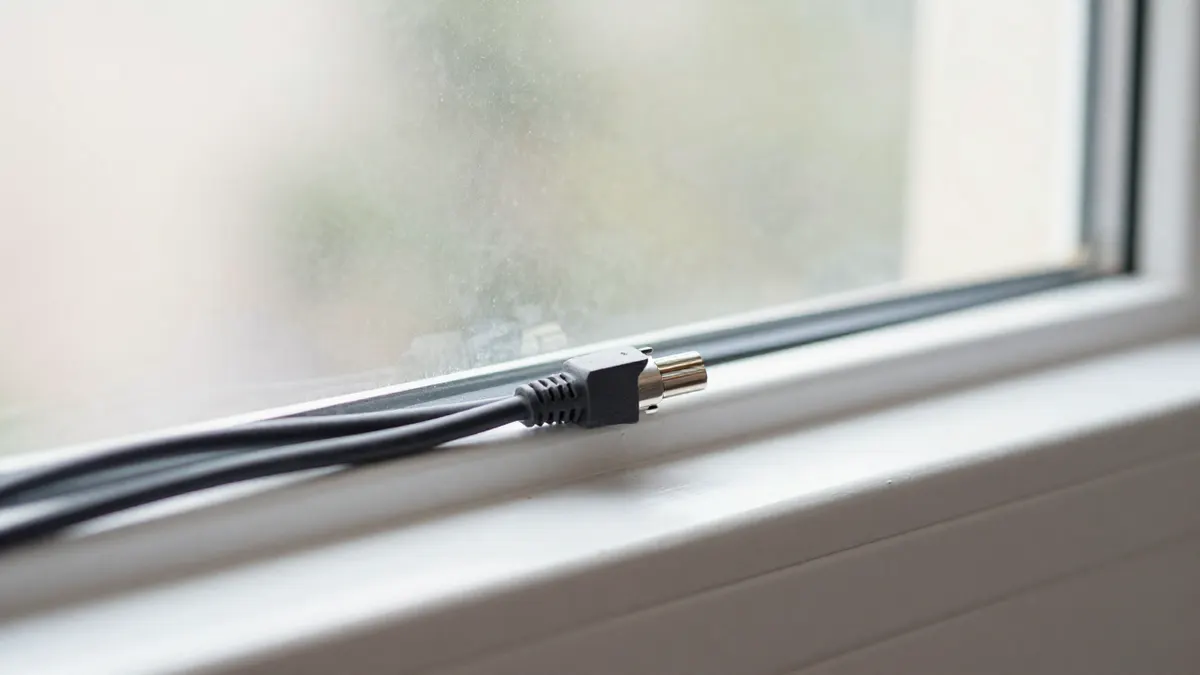
What the 45cm cable is made of
The cable is a low loss coax with a 50 ohm impedance, which is what LoRa gear expects. Attenuation at 868 MHz is low for such a short length, usually well under 0.5 dB across 45cm. That is almost nothing next to what a closed window can cost you.
The connectors matter more than people think. SMA-RP male (reverse polarity, with a female pin inside the thread) plugs into the hotspot. The N male end screws onto an outdoor antenna fitted with an N female base. Check both genders before you buy anything, because a mismatch is the most common mistake with this kind of lead.
Helium antenna window cable: when it makes sense
It suits flats, rented rooms and any home where drilling a wall is not allowed. The flexible, flat section near the middle slips into the gap between sash and frame. The window then closes on it with little pressure on the cable.
If your hotspot already sits on a high shelf next to a south-facing window, an indoor stub antenna may be enough. Once the window is double glazed with a low-e coating, though, an outdoor antenna usually does better. Gains of 3 to 6 dB are realistic with a 3 to 5 dBi outdoor model compared with a stock indoor whip.
How to route it without damaging it
- Dry fit everything first: hotspot, cable and antenna, with the window closed on the cable.
- Keep the bend radius above roughly 3cm. Tight kinks change the impedance and can break the shield.
- Put the N connector outside, and add self-amalgamating tape around it so rain cannot get into the thread.
- Leave a small drip loop so water runs off the cable before it reaches the connector.
Do not force a window shut on a round, rigid section. If the gap is too tight, a flat design is kinder to the cable. See Flat coaxial cable SMA-RP for how that format differs, and Window pass-through SMA cable for the general principle behind these leads.
Length: why 45cm is a trade-off
Forty-five centimetres is short on purpose. It places the antenna right outside the window, which keeps loss tiny. But it also means the hotspot must sit near the glass, within about 30cm of the frame once you account for the routing.
If your router or power socket is further from the window, a longer lead helps. A 50cm window pass-through cable gives you a little more room for a tidy bend, and longer coax runs of 3 to 5 metres can work too, at a higher cost in signal. As a rule, each extra metre of thin coax at 868 MHz can add around 0.5 to 1 dB of loss, so the shortest lead that reaches is the best one.
Signal and placement tips
- Mount the antenna vertically, with the tip pointing up.
- Keep it at least 30cm away from metal railings and walls.
- A position above roof gutters or window ledges clears the nearest obstacles.
- Avoid sandwiching the antenna between a window and a shutter.
Height beats almost everything else. A basic antenna on a second-floor window will often cover more ground than a fancy one at ground level.
Frequently Asked Questions
Will a window cable reduce my Helium signal?
Slightly, but far less than a closed window does. Over 45cm the cable loses a fraction of a decibel at 868 MHz. Most of the benefit from moving the antenna outside is kept.
Can I use it with any LoRaWAN hotspot?
It works with any hotspot that has an SMA-RP female antenna port, which covers many common indoor miners. Check your device manual first. Some models use a different connector or an internal antenna only.
Is the cable waterproof?
The jacket handles light weather exposure, but the connectors are not sealed by themselves. Wrap the outdoor N connection with self-amalgamating tape and keep it pointing downward where possible.
Can the window close on it?
Usually yes, if the cable passes through a gap of a few millimetres and the seal is soft. Test it by closing the window gently and checking that the hotspot still reports a good signal. Never crush the coax against a hard metal edge.