50cm Window Pass Through Antenna Cable for LoRaWAN Hotspots
A 50cm window pass through antenna cable is a flat, thin coaxial lead that slips between a window frame and its seal, so an antenna can sit outside while the miner stays indoors. The SF-SM version has a female connector on one end and a male on the other. That detail matters, and we come back to it below.
The flat profile is the whole point. A normal round cable pinches in a closed window and lets in drafts. A flat one, usually around 1 to 1.5 mm thick, lies in the gap and the window shuts almost normally.
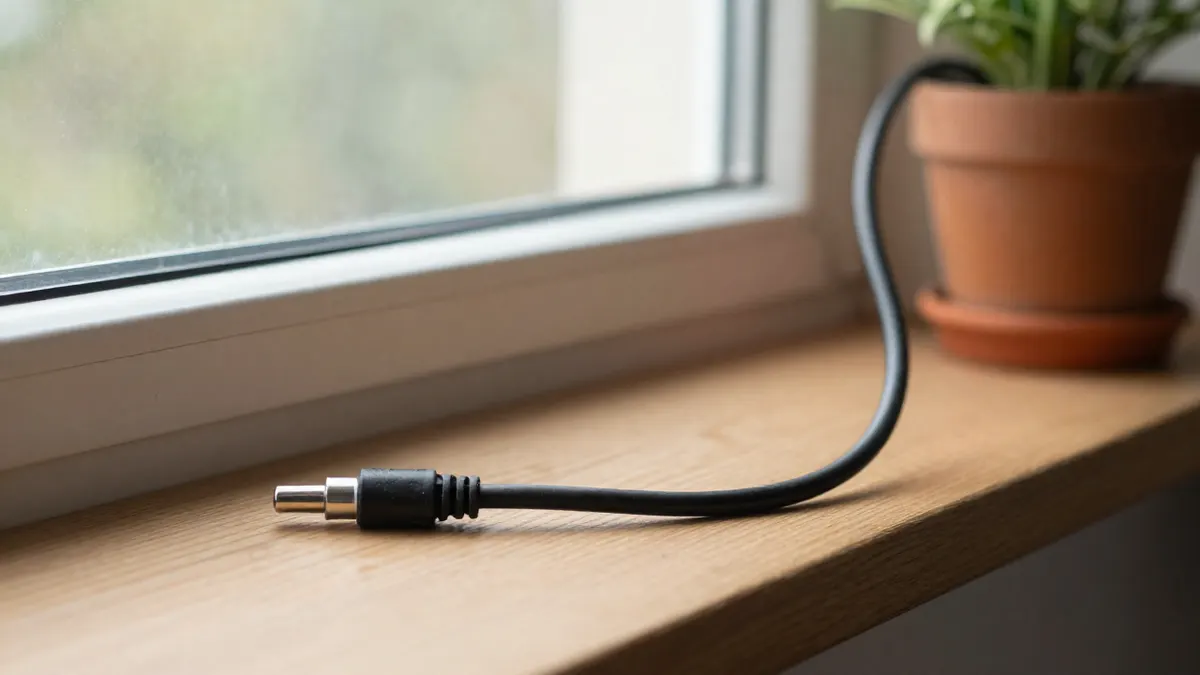
What the 50cm window pass through antenna cable is for
Helium and other LoRaWAN hotspots work best with the antenna high and clear of walls. Glass and brick eat into the 868 MHz signal, which is the band used across Europe. Putting the antenna on the outside of a window, or on a sill bracket, often gives a noticeable gain in coverage compared with leaving it next to the miner.
At 50cm the cable is short on purpose. It bridges the window frame and not much more. If you need to reach a balcony rail or a pole a few meters away, a longer lead is a better fit, and the 100cm window pass through cable covers that case.
Signal loss at 50cm
Flat cables lose more signal than thick low loss coax. At 868 MHz, expect roughly 0.5 to 1 dB lost over 50cm, depending on the build. That is small. Over 3 meters the same flat cable could lose 3 to 5 dB, which cancels the benefit of moving the antenna outside.
So keep the flat section short. Use it only to cross the window, then connect the antenna directly or with a very short low loss jumper such as a 15cm low loss coaxial cable.
Connector types and gender
SMA connectors come in standard and reverse polarity versions, and mixing them gives no signal. Check three things before you connect anything:
- The port on your miner (many LoRa hotspots use SMA female, but some use RP-SMA)
- The base of your antenna
- The gender at each end of the cable
If the miner port and antenna are both standard SMA, a cable with one female and one male end works as an extension. A mismatch in polarity needs an adapter or a different cable. A Flat coaxial cable SMA-RP is the version to look at when your equipment uses reverse polarity.
Installing it in a window
Choose the right spot
Casement windows with a rubber gasket work best. Sliding sash windows and old wooden frames can be harder, since the gap may be uneven. Tilt the window open, lay the cable across the frame at a corner, and close it gently.
Protect the cable
Do not fold the cable sharply at the edge. Keep a bend radius of at least 2 to 3 cm, and never force the window latch. A crushed center conductor changes impedance and can quietly ruin performance. If the window leaves a visible gap, a thin strip of foam tape on each side stops drafts and rain.
Weather
Connectors left outside should be wrapped with self-amalgamating tape, then a layer of electrical tape. Water in an SMA joint is the most common cause of a hotspot that slowly loses its edge over a winter.
Pairing it with an antenna
A 3 to 5 dBi fiberglass or whip antenna is a sensible match for a window mount. Higher gain antennas narrow the vertical beam, which is fine on flat ground but poor from a high apartment. For a wider overview of antenna choice, see the Helium antenna window cable guide.
Frequently Asked Questions
Can I use a 50cm window pass through antenna cable with any hotspot?
Only if the connectors match. Check whether your miner uses SMA or RP-SMA and which gender the port is. The cable should have the opposite gender to what it plugs into.
Does the cable damage window seals?
Not usually. The flat body is thin enough for most rubber gaskets. Avoid leaving it under strong pressure for years, and check the seal once a season.
Is 50cm too short?
For crossing a window frame it is enough. If the antenna must sit farther from the glass, choose a longer lead, accepting a bit more loss.
Will it affect my rewards or coverage?
Moving the antenna outside usually improves line of sight, which helps coverage. The cable itself adds only a fraction of a dB, so the net result is normally positive.