4 dBi Helium Outdoor Antenna for EU868 Hotspots
A 4 dBi helium antenna sits in the middle of the range for LoRaWAN hotspots in Europe. It is a fiberglass omnidirectional whip, tuned to the 863 to 870 MHz band, and it usually comes with an N-type female connector and a mounting bracket for a pole or mast.
Gain of 4 dBi gives a flatter radiation pattern than the 3 dBi stock rubber ducks, but not so flat that it misses nearby devices. That balance is why many people choose it for rooftops and balconies.
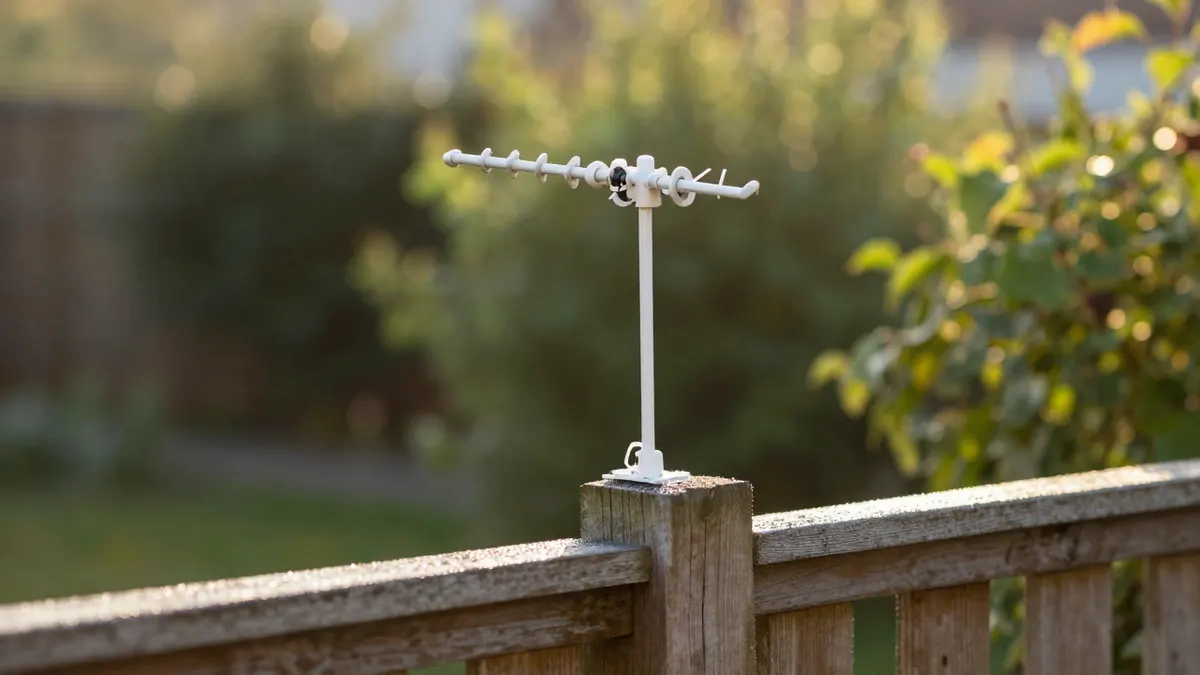
What a 4 dBi helium antenna actually does
Gain does not create signal. It reshapes it. An omnidirectional antenna pushes energy toward the horizon and away from the sky and ground, so a higher number means a thinner doughnut of coverage.
At 4 dBi the vertical beamwidth is roughly 30 to 40 degrees. That is wide enough to serve sensors on a lower floor or a hillside slightly below your mast, which a very high gain whip would overshoot.
Typical specifications for an outdoor unit of this class:
- Frequency: 863 to 870 MHz (EU868)
- Gain: about 4 dBi
- Polarization: vertical
- Impedance: 50 ohms
- Length: roughly 30 to 45 cm
- Ingress rating: IP65 or better
4 dBi outdoor antenna for EU868: where it works best
Flat or gently rolling terrain suits it well. In a suburb with two-storey houses, a mast at 6 to 8 metres can reach devices several kilometres away in line of sight, and often 1 to 2 km through light clutter.
In dense city blocks the picture changes. Buildings absorb and reflect 868 MHz, so real range drops to a few hundred metres, and height matters far more than another dBi of gain.
Hilly sites are the awkward case. If your hotspot sits at the top of a slope and most devices are below, a very high gain antenna will shoot over their heads. The 4 dBi pattern copes better.
Choosing between neighbouring gains
A 3 dBi helium antenna is the safer pick when devices are close and at mixed heights, for instance across a farm yard or a small estate. A 5.8 dBi helium antenna stretches the horizon further on flat ground but needs the mast to be vertical and the surroundings open.
Pick 4 dBi when you are not sure. It rarely hurts, and it is easy to swap later.
Cable, connectors and mounting
The cable run can undo what the antenna gains. Common LMR-240 type coax loses around 0.3 dB per metre at 868 MHz, so a 10 metre run eats about 3 dB. That is nearly the whole gain you paid for.
Keep the cable short. If the hotspot can live in a weatherproof box near the mast, run the network cable instead and keep the radio cable under 3 metres.
- Seal every outdoor connector with self-amalgamating tape, then wrap it in vinyl.
- Leave a drip loop so water runs off before reaching the connector.
- Mount the antenna at least 1 metre from metal roofing, gutters and other masts.
- Keep it upright. A tilted whip pushes the lobe off the horizon.
Add a lightning arrestor if the mast is the tallest thing on the street. Units cost around 10 to 20 EUR and must be earthed properly to do anything.
Is 4 dBi enough, or do you need a directional panel?
If all your target devices are in one direction, such as a field edge or a single building, a directional model beats any whip. A 12 dBi panel antenna concentrates the beam and can reach well past 5 km in open country, though it leaves a dead zone behind it.
For a typical home hotspot with devices all around, stay omnidirectional.
Legal limits in the EU
EU868 sub-bands carry power limits, commonly 14 dBm ERP on the main channels and up to 27 dBm on the 869.4 to 869.65 MHz band. Radiated power counts antenna gain minus cable loss, so a 4 dBi antenna on a short cable stays comfortably inside typical hotspot settings. Check your national rules if you change gear.
Frequently Asked Questions
How far can a 4 dBi helium antenna reach?
In open line of sight, several kilometres is realistic with the antenna at 6 to 10 metres. In towns, expect 300 to 1000 metres. Obstacles and mounting height change the result more than the gain does.
Can I use a 868 MHz antenna on a 915 MHz hotspot?
It is a bad idea. The antenna is tuned for a different band, so reflected power rises and range falls. Match the antenna to your regional frequency plan, which is EU868 for most of Europe.
Does a longer cable matter with a 4 dBi antenna?
Yes, a lot. Each metre of thin coax costs roughly 0.3 dB at 868 MHz, so a long run can cancel the gain. Thicker low-loss cable helps if you cannot shorten the run.
Which connector does it use?
Most outdoor models use an N-type female on the antenna. Your hotspot may have an SMA or RP-SMA port, so you will usually need a short pigtail adapter. Check the port before you plan the cable.