5.8 dBi Helium Outdoor Antenna (EU 868)
A 5.8 dBi Helium antenna is a fibreglass omnidirectional model tuned for the 863 to 870 MHz band used by LoRaWAN in Europe. It sits in the middle of the gain range, which makes it a sensible default for rooftops, balconies and masts in towns and suburbs. Typical length is around 50 to 60 cm, with an N-female connector at the base.
Gain is the first thing people ask about, so here is the short version. Higher gain squeezes the signal into a flatter disc around the antenna. You get more reach toward the horizon and less energy straight up or down.
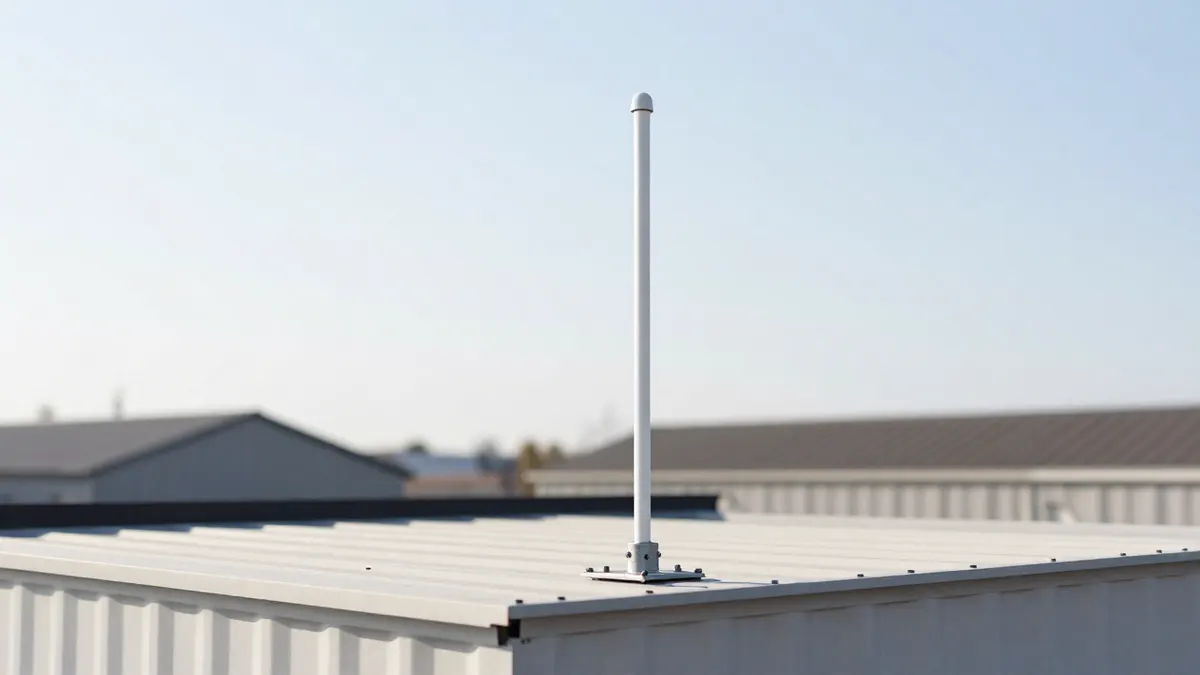
What a 5.8 dBi Helium antenna actually does
On a clear roof with a good line of sight, a hotspot with this antenna can reach other LoRa devices at roughly 5 to 10 km. In dense city streets the figure drops to 1 or 2 km, because buildings absorb and reflect 868 MHz signals. Those numbers are indicative. Height matters more than almost anything else.
The vertical beamwidth is about 20 to 25 degrees. That is fine on flat ground. If your hotspot sits at the top of a tall building and most sensors are far below, a lower gain model may cover the street better, and a 4 dBi helium antenna is worth a look for that case.
Who it suits
- Houses and low apartment blocks in suburbs
- Rooftop or chimney mounts on flat or gently rolling terrain
- Small towns where the nearest sensors are a few kilometres away
- Pole mounts at 5 to 12 m above ground
5.8 dBi outdoor antenna EU868: what to check before you pick one
Frequency first. Many antennas sold for the US are tuned to 902 to 928 MHz and perform poorly in Europe. Look for a stated range covering 863 to 870 MHz, and a VSWR below 1.5 at 868 MHz. If the listing gives no VSWR, treat it with suspicion.
Connector next. Most Helium hotspots use an N-female or SMA port, so confirm what your miner has and whether you need a short adapter. Every extra connector costs a little signal, roughly 0.1 to 0.3 dB each.
Then the build. Look for a UV-stable fibreglass radome, an IP67 rating or better, and a stainless mounting clamp that fits a pole of 30 to 50 mm. Cheap aluminium hardware corrodes within two winters near the coast.
Cable loss eats your gain
This is where many setups go wrong. A thin LMR-195 style cable loses around 0.5 dB per metre at 868 MHz, so 10 m of it wipes out most of what a higher-gain antenna gains you. LMR-400 loses about 0.15 dB per metre, which is a far better deal for runs beyond 3 m.
Put the hotspot close to the antenna when you can. A weatherproof enclosure on the mast, with power over Ethernet running down to the house, beats a long coax run almost every time.
Installing the antenna for the best range
Mount it vertically. Even a few degrees of tilt reshapes the pattern, and a leaning antenna loses range in one direction.
Keep at least 1 m of clear space from walls, metal roofing and other antennas. Wi-Fi routers and cellular masts nearby are less of a problem at 868 MHz, but a metal pole running right alongside the radiator will distort the pattern, so use a side-arm bracket instead of strapping the antenna flat to the pole.
Seal the N connector with self-amalgamating tape, then add a layer of vinyl tape over it. Water in the connector is the most common cause of an outdoor antenna slowly going dead.
Legal limits in Europe
The EU868 band limits radiated power, commonly to 14 dBm ERP on much of the spectrum and up to 27 dBm on the 869.4 to 869.65 MHz sub-band. A hotspot's output plus antenna gain minus cable loss must stay within the limit for your country. Check your national regulator before swapping to a high-gain model, because the rules differ slightly between states.
Comparing it with other gain options
Moving up the range, a 6 dBi helium antenna gives a marginal bump with a slightly flatter pattern, while an 8 dBi outdoor antenna suits long, level lines of sight such as open farmland or coastal areas. Going from 5.8 to 8 dBi adds about 2 dB, which is real but modest. It narrows the vertical beam further, so tilt and height errors hurt more.
My view: if you are unsure, 5.8 dBi is the safer pick. It forgives a less than perfect mounting spot, and the extra reach of bigger models only pays off on very open terrain. For a wider look at what is available, any Helium antenna shop worth browsing should list gain, frequency range and connector type clearly for each model.
Prices for this class of antenna usually start at about 20 to 40 euros for basic fibreglass units, and reach 60 euros or more for well-made models with better hardware. Treat these as rough guides only.
Frequently Asked Questions
Is a 5.8 dBi antenna better than the stock antenna?
Usually yes, if the stock one is a small 2 to 3 dBi whip and you move it outdoors. The gain is higher and the position is better, and both help. Indoors behind walls, the improvement is much smaller.
Can I use a US 915 MHz antenna on an EU868 hotspot?
You can physically connect it, but performance suffers because it is tuned to the wrong band. The mismatch raises reflected power and cuts range noticeably. Use an antenna rated for 863 to 870 MHz.
How high should I mount it?
As high as is practical and safe, ideally above surrounding rooftops and trees. Going from 3 m to 10 m can double your effective reach. Always respect local rules for masts and make sure it is properly earthed.
Does a higher dBi number always mean more range?
No, it only means the signal is focused more tightly toward the horizon. On uneven ground or from a tall building, a mid-gain model often covers more devices than a high-gain one.