RP-SMA Gender Coupler: Plug-to-Socket Extension for LoRaWAN
An RP-SMA male to RP-SMA female adaptor is a short coupler with a threaded plug on one end and a threaded socket on the other, both in reverse polarity format. It does not convert anything. It simply joins two RP-SMA parts, or gives you a few extra centimetres of reach, or lets you change the direction of a connector. Most units are 15 to 30 mm long and weigh a few grams.
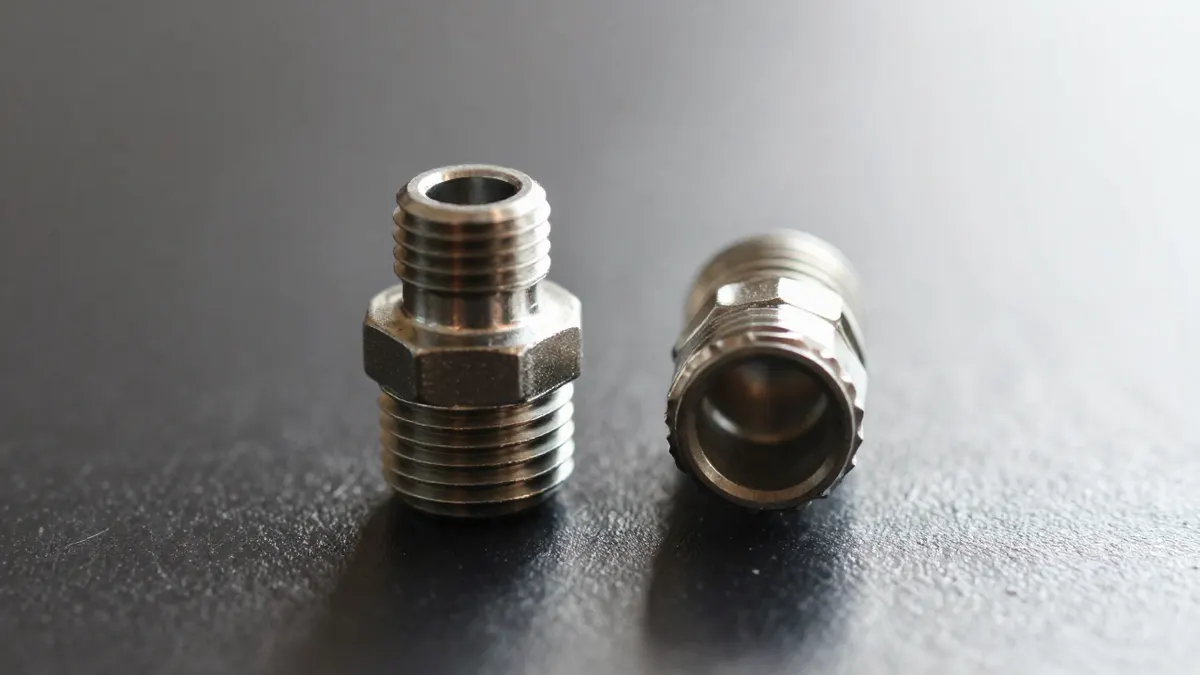
How RP-SMA gender works
This is where people get stuck. On a standard SMA connector, "male" means the plug has an outer thread and a center pin. Reverse polarity swaps the center contact. An RP-SMA male has an outer thread (or a nut) like its SMA cousin, but a female-style socket inside. An RP-SMA female has an internal thread and a center pin.
So the name describes the thread and the inside contact separately, which is why two connectors that look alike on the bench can refuse to mate. Check the center of the connector, not just the thread.
When an RP-SMA male to RP-SMA female adaptor makes sense
Common cases on a LoRaWAN or Helium-type hotspot:
- Moving the antenna a little away from the case, so it clears a metal bracket or a window frame.
- Turning the antenna 90 degrees when the enclosure sits against a wall.
- Joining an RP-SMA male pigtail to an RP-SMA female port on an antenna or filter, where both ends happen to be the wrong gender.
- Adding a test point for a power meter or analyzer during setup.
If your two ends already mate directly, skip it. Every extra junction adds loss and one more spot for water to creep in.
Signal loss and what to expect
A decent adaptor costs the signal about 0.1 to 0.3 dB at 868 MHz. That is small. Cheap nickel-plated ones with loose tolerances can reach 0.5 dB or more, and they tend to loosen with vibration. Prices usually start at around 2 to 5 euros for a plain one, and gold-plated brass types sit a bit higher.
On a short indoor run the loss barely matters. On a long outdoor feed, where every dB counts, you want fewer joints and better cable. A low-loss run such as an LMR-400 antenna cable is worth more than any adaptor tweak, since 10 metres of thin RG174 can eat 3 dB or more at 868 MHz while LMR-400 loses roughly 0.4 dB over the same stretch.
Choosing a good one
- Brass body with gold or nickel plating, not zinc alloy.
- PTFE insulation around the center contact.
- A rated frequency range that covers at least 0 to 6 GHz, which easily includes 868 MHz and 915 MHz.
- A 50 ohm impedance mark. Anything else is a red flag.
Hand-tighten, then give a quarter turn with a small wrench at most. Over-torquing strips the thread and can crush the dielectric.
Mistakes that cost range
The first is mixing up RP-SMA and plain SMA. They screw together part way, then fail, and forcing them can bend the pin. If you actually need to bridge the two standards, an RP-SMA female to male adaptor is a different part with a different job, so read the labels carefully.
The second is stacking three or four adaptors to reach something. Each one is another source of mismatch. A single proper jumper cable does the same job better.
The third is skipping weatherproofing outdoors. Wrap the joint with self-amalgamating tape, then a layer of vinyl tape over it. Water inside a connector shifts the impedance and can turn a good link into a dead one within weeks.
Using it with filters and external antennas
If your hotspot sits near cellular towers or pagers, a SAW bandpass filter EU868 can cut out-of-band noise. These filters often come with an RP-SMA port on one side, so a male to female adaptor may be the missing link between filter and antenna lead. Keep the order simple: antenna, filter, short jumper, radio.
For roof-mounted antennas with an N-type feed, a cable such as an LMR-400 N-female to SMA-RP-male already ends in the right connector, so you may not need any extra coupler at all.
Frequently Asked Questions
Is an RP-SMA male to RP-SMA female adaptor the same as an extension cable?
No. The adaptor is a rigid piece a few centimetres long and adds only a small gap. An extension cable is flexible, runs from 20 cm to several metres, and suits any case where the antenna must sit away from the device.
Will it work at 868 MHz and 915 MHz?
Yes. Almost every 50 ohm RP-SMA adaptor handles frequencies up to 6 GHz, so both LoRa bands are well inside its range. Loss stays under about 0.3 dB for a decent part.
How can I tell RP-SMA from SMA?
Look at the center of each connector. If the threaded plug shows a hole where you expect a pin, it is reverse polarity. Comparing it with a known part, or checking the labelling on the radio, settles any doubt.
Can I use one outdoors?
Only with sealing. The connector itself is not waterproof, so cover it with self-amalgamating tape and a protective wrap, and point the joint downward where possible.