HHS-400 N-Female to SMA-Male Cable: What It Does and When to Use It
The HHS-400 N-female to SMA-male cable is a short low-loss coax jumper. One end has an N-type socket (female), the other an SMA plug (male). It lets a device with an SMA-female antenna port connect to an outdoor antenna or lightning arrestor that ends in an N-male plug.
Most LoRaWAN hotspot miners and gateways use SMA or RP-SMA ports on the housing. Most outdoor fiberglass antennas use N-type connectors. This cable bridges that gap.
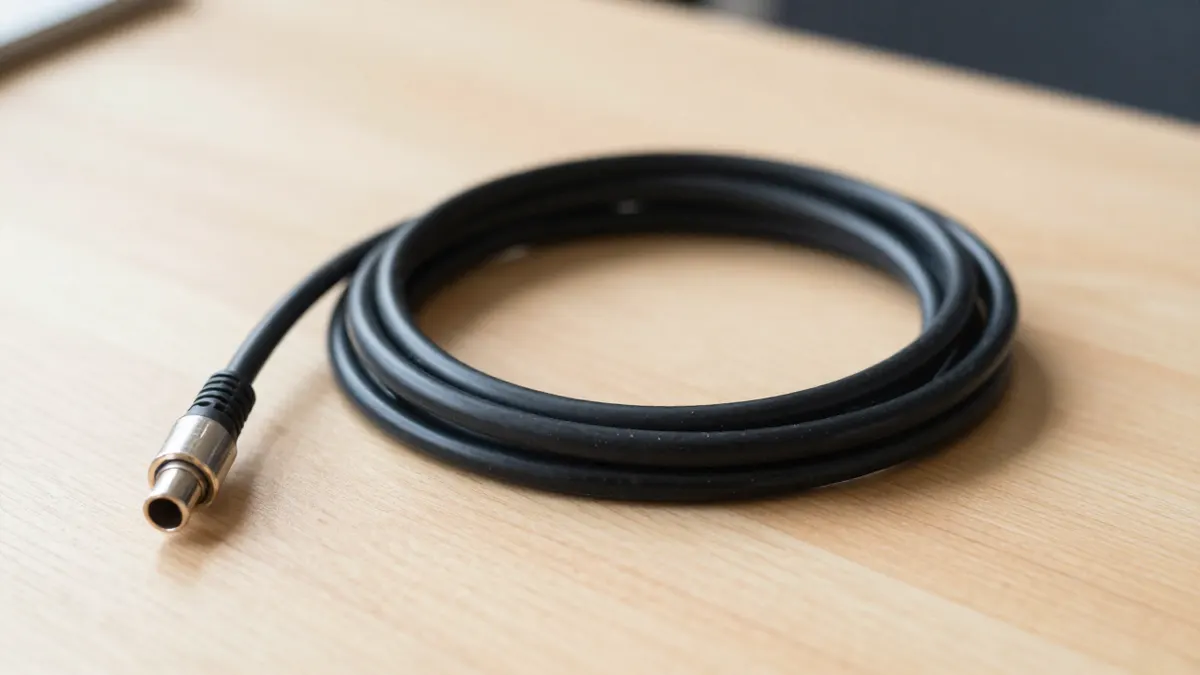
Connector gender: check before you order anything
Gender mix-ups cause most returns of RF cables. Look at the center pin, not the thread. A male connector has a pin in the middle, a female one has a socket.
For this cable, the N-female end takes an N-male plug. The SMA-male end screws onto an SMA-female port. If your hotspot has a pin in its antenna port, you need a different cable.
SMA versus RP-SMA
Standard SMA and reverse-polarity SMA look almost identical. They do not mate. Standard SMA-male has an outer thread and a center pin. RP-SMA-male has the same outer thread but a socket inside. Many Wi-Fi and some LoRa devices use the reverse type, so read the label or the datasheet. If your device needs the reverse type, look at the HHS-400 N-male to SMA-RP-male instead.
Cable specs worth knowing
The HHS-400 is a 50 ohm coax in the same class as LMR-400, with a roughly 10 mm outer diameter. That is thick for a jumper, and the bend radius is around 25 mm for a one-time bend and about 50 mm for repeated flexing.
Typical attenuation for this class of cable sits near 0.22 dB per meter at 868 MHz and about 0.24 dB per meter at 915 MHz. These are rough figures, so check the datasheet of the exact cable.
- Impedance: 50 ohm
- Frequency range: DC to several GHz, so it covers 433, 868 and 915 MHz bands
- Typical lengths: 0.5 m, 1 m, 3 m, 5 m and 10 m
- Indicative price: from about 10 to 35 EUR depending on length
How long should the cable be?
Short, always. Every meter at 868 MHz costs about 0.2 dB, so a 10 m run loses around 2.2 dB before you count connectors. Each connector adds another 0.1 to 0.2 dB.
A 3 m cable loses roughly 0.7 dB, which is easy to live with. At 10 m you lose about 40 percent of your transmit power on the way to the antenna, and received signals shrink by the same amount. If the antenna must sit far from the miner, move the hotspot closer to the antenna instead and run Ethernet or PoE for the long stretch. Ethernet carries 100 m without trouble.
Typical Helium hotspot setup
The common chain is hotspot, then this jumper, then a lightning arrestor, then the antenna mast. The arrestor is usually N-female to N-female, so the plug on the antenna side must be N-male. Here the N-female end of this cable takes a male plug on an antenna pigtail or adapter.
Keep the SMA end hand-tight plus a small quarter turn. Overtightening SMA with pliers damages the thread and can crack the hotspot's board connector. Water is the other enemy. Wrap outdoor N joints with self-amalgamating tape, then a layer of vinyl tape over it.
HHS-400 versus LMR-400 alternatives
The two cable types are close in size and loss, so they are nearly interchangeable for a hotspot. The HHS-400 antenna cable page covers the bulk cable in more detail. If you prefer a branded LMR build, the LMR-400 N-female to SMA-male version has the same connector layout, and the wider LMR-400 antenna cable family includes other connector pairings.
The jacket and the braid quality vary by maker. Cheap cables sometimes use thinner shielding that raises loss by 10 to 20 percent. Avoid unmarked cables with no stated attenuation.
Frequently Asked Questions
Will this cable work with a Helium hotspot?
Yes, if the hotspot has an SMA-female antenna port and your antenna has an N-male connector. Check the port gender and polarity first, since some devices use RP-SMA.
How much signal do I lose with a 5 m cable?
Roughly 1.1 dB from the cable itself at 868 MHz, plus around 0.3 dB for two connectors. That is about 1.4 dB in total, which is acceptable for most outdoor installs.
Can I use it outdoors?
The cable jacket usually handles sun and rain, but the connectors do not stay sealed alone. Wrap each joint with waterproof tape and let the cable drip downward before it enters a building.
Is it suitable for Wi-Fi or 4G?
It works electrically up to a few GHz, but loss rises with frequency. At 2.4 GHz expect around 0.4 dB per meter, so keep runs very short.