Mast Pole Clamp 40-60mm for Helium Antenna Mounting
A mast pole clamp 40-60mm grips round tubes with an outer diameter anywhere between 40 and 60 millimetres. That covers most galvanised steel poles, aluminium masts and old TV antenna tubes found on European roofs, balconies and gable ends. If your pole measures 48 mm or 50 mm, which are the two most common sizes, it fits without any adapter.
For a Helium or LoRaWAN hotspot, the clamp is the part that decides whether your antenna stays put through a storm. Here is what to check before you pick one.
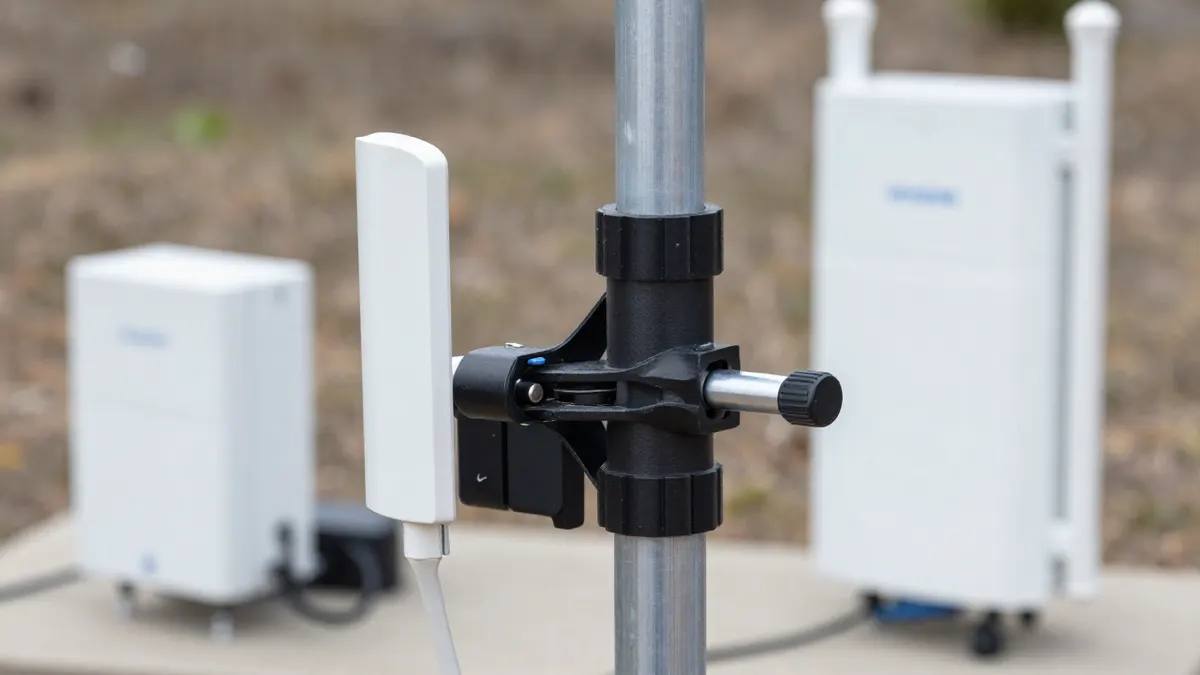
What a mast pole clamp 40-60mm actually holds
Most clamps in this range are a two-part design. A fixed bracket plate carries the antenna or a short arm, and a U-bolt or a stainless band wraps around the pole. Tightening two nuts pulls the plate against the tube.
Typical load is modest. A fibreglass 5 to 8 dBi antenna weighs 0.3 to 1.2 kg and is 60 to 120 cm long, so even a light clamp handles the weight. Wind is the real force. A 1 m fibreglass whip in a 100 km/h gust pushes sideways far harder than it pulls down.
Measure the pole first
Wrap a piece of string around the pole, mark it, and measure the length. Divide by 3.14 to get the diameter. A reading of 150 mm gives roughly 48 mm, which sits comfortably inside the range.
Poles below 40 mm slip inside the clamp even when tight. Poles above 60 mm leave the U-bolt too short. Neither case ends well, so measure twice.
Materials and corrosion
Hot-dip galvanised steel is cheap and strong, usually from around 5 to 12 EUR for a basic clamp. Stainless steel (A2 or A4) costs more, often 12 to 25 EUR, and lasts longer near the coast. A4 is the better pick within 20 km of salt water.
Avoid mixing metals where you can. An aluminium pole with a plain steel U-bolt will corrode at the contact points within a couple of years, especially in damp climates. If you must combine them, put a plastic washer or a smear of anti-seize grease between the two.
Installing the clamp step by step
- Choose a pole section that is solid and straight, at least 15 cm below the top, so the antenna clears the end.
- Place the bracket plate on the side facing the antenna direction and the U-bolt around the back.
- Tighten both nuts evenly, a little at a time, until the clamp no longer turns by hand.
- Add a second clamp 20 to 30 cm lower for any antenna longer than 80 cm.
- Check again after the first strong wind and after a month of temperature swings.
A torque of about 8 to 12 Nm suits M8 nuts on a steel pole. Thin aluminium tubes can dent at that level, so go lighter and rely on a rubber shim instead.
Keep the antenna vertical
Collinear LoRaWAN antennas radiate best when they stand upright. Use a spirit level or a phone level app. A tilt of more than 5 degrees noticeably shrinks coverage toward the horizon, which is where your distant sensors and neighbours' hotspots sit.
Cable, spacing and lightning
Keep the antenna at least 1 m away from the pole top if the pole is metal, and at least 30 cm from other antennas. A metal mast right beside the radiator distorts the pattern. An offset arm of 20 to 40 cm helps a lot.
Leave a drip loop in the coax before it enters the building, and wrap every outdoor connector with self-amalgamating tape. Water in an N-type connector is the most common reason a good hotspot suddenly loses range. Where local rules require it, ground the mast with a 6 mm² copper conductor.
Other ways to mount when there is no pole
Not every site has a tube to grab. For a railing position, an Helium antenna balcony mount avoids drilling into the building. On a sloping roof, a Tile base antenna mount lets you raise a short pole without piercing the tiles.
On a plain masonry wall, an Antenna wall mount bracket is the simplest answer, and in exposed spots a Heavy duty antenna wall mount handles longer masts and stronger gusts. You can then fix your 40-60 mm clamp onto the pole that the bracket carries.
Frequently Asked Questions
Will a 40-60mm clamp fit a 63 mm pole?
No. The U-bolt will not close around it, and forcing it risks snapping the thread. Look for a clamp rated for 60-80 mm instead.
Can I use one clamp for a 1 m antenna?
For a light fibreglass model on a short mast, yes. In windy areas, add a second clamp 20 to 30 cm lower so the antenna cannot twist or lean.
Does the clamp affect signal strength?
The clamp itself does not, but its position can. Keep metal parts away from the radiating section and mount the antenna above the clamp, not beside it.
How often should I check the bolts?
Check after the first storm, then every 6 months. Thermal cycling loosens nuts slowly, and a quick turn with a spanner takes under five minutes.